
Mastering Commercial Floor Leveling: Your Guide to Flawless Surfaces
Uneven concrete floors in commercial settings aren’t just an eyesore; they’re a serious safety risk, a drain on operations, and a recipe for expensive repairs. This guide dives deep into proven floor leveling techniques for commercial spaces, showing you how to restore flat, robust surfaces and keep your business running smoothly. We’ll break down the core methods—from advanced self-leveling compounds to precision polyurethane injection and expert concrete grinding—explain how to tackle uneven slabs, match the right solutions to warehouses, offices, and parkades, detail essential materials, and help you make the best choice. Whether you’re managing a bustling distribution center or a sleek retail outlet, these insights will equip you to boost safety, extend your floor’s life, and achieve a flawless finish.
What Are the Top Commercial Floor Leveling Techniques?
Commercial floor leveling techniques are all about creating perfectly uniform surfaces. They achieve this by filling low spots, lifting sunken slabs, or shaving down high points, ultimately enhancing safety, durability, and appearance. Three primary methods stand out in today’s repair projects:
How Does Self-Leveling Concrete Work for Commercial Floors?
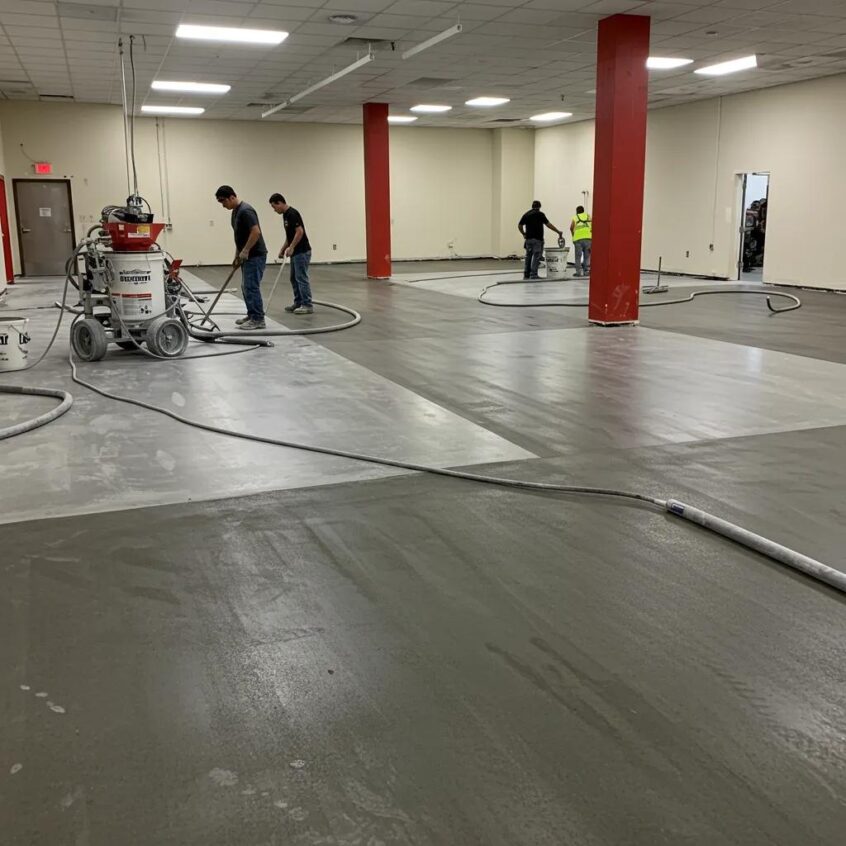
Self-leveling concrete is a game-changer. It’s a polymer-modified cementitious compound designed to flow effortlessly under its own weight, filling in every surface imperfection. Our technicians simply mix the product with water and pour it onto the prepared subfloor. It then spreads out, creating a smooth, flat layer all on its own. This method boasts rapid cure times, a seamless finish, and works beautifully with a wide range of floor coverings.
What Is Polyurethane Injection and How Does It Lift Sunken Concrete Slabs?
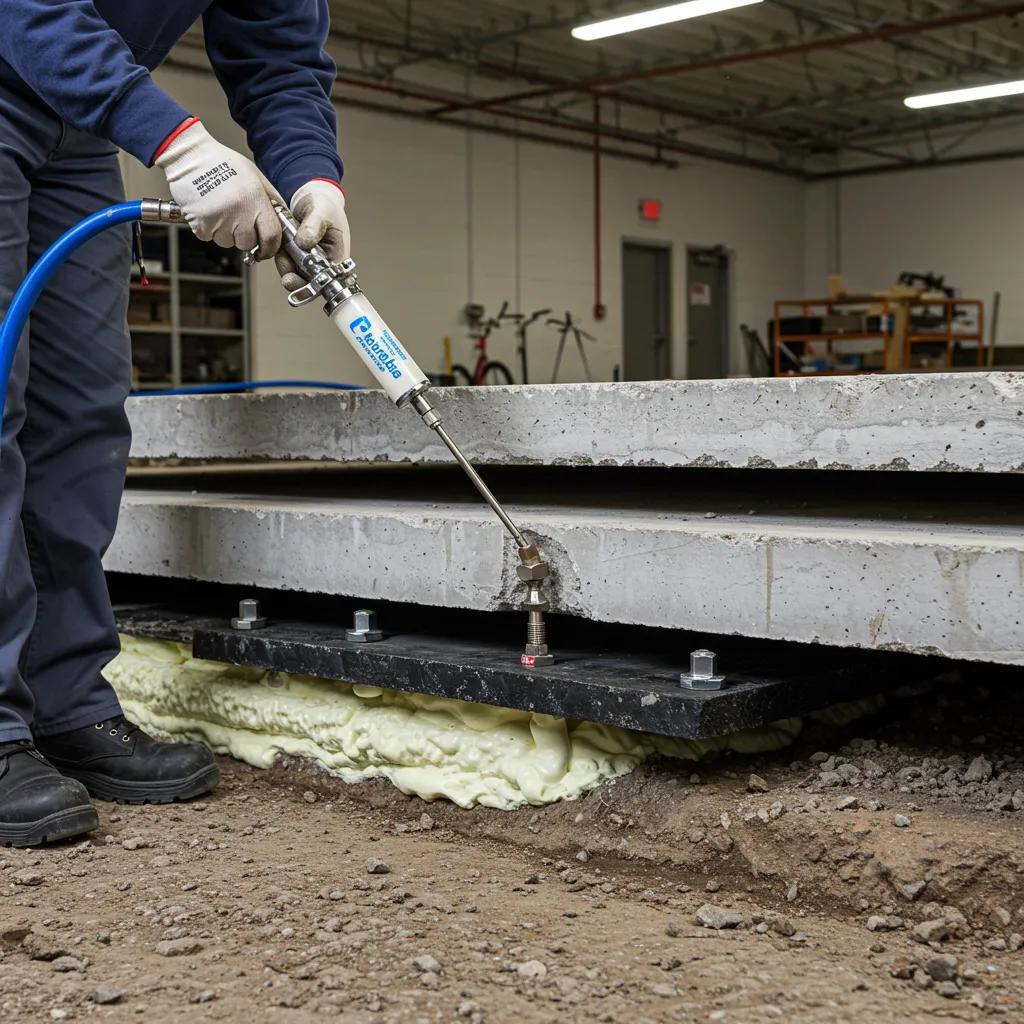
Polyurethane injection, often called slab jacking, is a precise technique. We drill small access ports into a sunken slab and then inject a high-density foam underneath. This expanding foam fills any voids, gently lifts the slab back to its intended elevation, and then cures in place, providing robust support for heavy loads. This method means minimal disruption, incredibly accurate adjustments, and long-lasting stability.
When Is Concrete Grinding Used in Commercial Floor Leveling?

Concrete grinding is the go-to method for tackling high spots, stubborn adhesive residues, and old surface coatings. We use specialized grinders equipped with diamond segments to precisely shave down uneven areas. This allows us to make targeted corrections without adding any material. Grinding is the perfect solution when you need to eliminate localized trip hazards or achieve a perfectly flat profile before applying a new overlay.
How Do These Techniques Compare in Cost and Efficiency?
Here’s a quick look at the typical cost ranges and downtime associated with each commercial floor leveling approach.
Self-leveling concrete offers a seamless finish at a moderate price point. Polyurethane injection is unmatched for minimizing operational interruptions, while grinding provides a cost-effective, targeted solution. For a comprehensive deep dive into each method, explore our Commercial Floor Leveling Services page.
How Do You Repair Uneven Commercial Concrete Floors?
Fixing an uneven commercial concrete floor starts with understanding why it’s uneven, then applying the right leveling technique to restore a safe, flat surface.
What Causes Uneven Concrete Slabs in Commercial Spaces?
Uneven concrete slabs often stem from underlying issues like soil settlement, erosion under unreinforced sections, or the immense pressure from heavy static loads concentrated in specific spots. Temperature swings and the relentless freeze-thaw cycle can also compromise the stability of the sub-base. Knowing these root causes is key to selecting the right leveling solution and preventing future problems.
By identifying whether low spots or high points are the main issue, you can determine the most effective path forward for restoration.
How Can Self-Leveling Compounds Fix Uneven Surfaces?
Self-leveling compounds are essentially fast-flowing cementitious mixtures that create a strong bond with existing slabs, forming a continuous, smooth top layer. After thorough surface preparation—which includes cleaning, priming, and repairing any cracks—our technicians pour the pre-mixed compound. It then naturally levels itself within minutes. This approach is perfect for correcting widespread undulations before installing tile, vinyl, or epoxy flooring.
- Achieves flatness tolerances of 1/8 in over 10 ft.
- Forms a robust bond with clean, properly profiled concrete.
- Reduces labor time thanks to efficient pump application.
With incredibly fast set times and minimal shrinkage, self-levelers create a uniform substrate that’s ready for your final floor finishes.
Effect of Chemical Admixtures on the Working Performance and Mechanical Properties of Cement-Based Self-Leveling Mortar
This research investigates how various chemical admixtures, such as cellulose ether, tartaric acid, and polycarboxylate superplasticizer, influence the workability and mechanical properties of cement-based self-leveling mortar. Findings indicate that these admixtures can enhance particle dispersion and improve fluidity, which are crucial for achieving a flat surface.
This research directly supports the article’s discussion on self-leveling concrete, its composition, and how it achieves a smooth, flat surface for commercial floors.
When Is Polyurethane Injection the Best Solution for Sunken Floors?
Polyurethane injection is the ideal choice when you need to precisely lift sunken slabs without the hassle of full panel replacement. Commercial areas that handle significant weight, like warehouses with active forklift traffic or areas with heavy machinery, greatly benefit from this high-lift capability. The expanding foam expertly conforms to irregular subgrade cavities and cures in under 30 minutes, restoring slab alignment and crucial structural support.
What Are the Signs That Concrete Grinding Is Needed?
Concrete grinding becomes essential when specific high spots, stubborn adhesive remnants, or built-up scale create tripping hazards or prevent new floor coverings from adhering properly. Visible surface ridges exceeding 1/16 in, uneven edges at expansion joints, or patched areas that protrude above the main slab are clear indicators that grinding is necessary before any leveling overlay can be applied to ensure a perfectly uniform profile.
Identifying these localized imperfections helps determine if grinding alone is sufficient or if a combined approach with self-leveling is the best route.
What Are the Best Floor Leveling Solutions for Different Commercial Spaces?
Choosing the right leveling method hinges on the specific demands and traffic patterns of each unique commercial environment.
How Are Warehouse Floors Leveled and Repaired?
Warehouse floor leveling demands exceptional compressive strength and the ability to get back to work quickly. For minor dips, we use fiber-reinforced self-leveling compounds. Sunken areas beneath racking systems are stabilized with polyurethane injection. High-traffic aisles are expertly ground to ensure smooth forklift operation. A comprehensive strategy often combines these methods to achieve both large-area flatness and resilience under heavy point loads.
What Floor Leveling Techniques Suit Retail and Office Spaces?
Retail and office environments require a perfect blend of safety and aesthetic appeal. Self-leveling compounds create stunning, seamless surfaces that are ready for carpet, tile, or wood. If settlement is localized, perhaps near an entrance, polyurethane injection can precisely correct elevations without disrupting your sales floor. Grinding is used to eliminate tripping hazards at partition joints or doorways.
How Is Parking Lot and Parkade Floor Leveling Addressed?
Parkades need to meet ADA compliance standards and manage water drainage effectively. Concrete grinding smooths out spalled areas and high points to prevent puddling, while polymer-modified overlays restore surface integrity on ramps. Polyurethane injection is used to lift sunken bays, maintaining consistent slopes for vehicle clearance and efficient water runoff.
Why Is Professional Commercial Floor Leveling So Important?
Professional commercial floor leveling ensures your surfaces meet stringent safety, performance, and aesthetic standards, while steering clear of the common pitfalls associated with DIY repairs.
How Does Floor Leveling Improve Safety and Prevent Trip Hazards?
By eliminating surface irregularities, commercial floor leveling effectively removes trip hazards that can lead to employee injuries and costly liability claims. A level slab supports consistent foot traffic, significantly reduces fall risks, and ensures threshold heights comply with all building codes.
In What Ways Does Floor Leveling Extend Floor Lifespan and Durability?
Creating uniform load distribution and preventing concentrated stress on weaker areas, floor leveling dramatically reduces the likelihood of cracking and surface wear. Properly leveled substrates also protect your final floor coverings—like epoxy or tile—from premature delamination and failure.
How Does Proper Floor Leveling Minimize Operational Disruptions?
Cutting-edge methods like fast-setting self-levelers and rapid-cure polyurethane injections allow commercial spaces to be back in service within hours. This swift turnaround minimizes costly production downtime, retail closures, and project delays.
What Are the Key Materials Used in Commercial Floor Leveling?
A variety of specialized materials are employed to achieve precise leveling results and ensure long-term performance in demanding commercial settings.
What Are Self-Leveling Compounds and Their Types?
Self-leveling compounds vary based on their composition and how quickly they cure. The table below highlights common formulations.
After reviewing these compound types, you can confidently select the ideal mix based on your needs for strength, thickness, and cure time.
Polymer-modified blends offer superior adhesion and flexibility, while fast-drying formulas are perfect for multi-shift installation schedules.
The Development of Nanoalumina-Based Cement Mortars for Overlay Applications in Concrete Floors
This study explores the use of nanoalumina in cement mortars for concrete floor overlays, demonstrating that the addition of 0.5% nanoalumina nanopowder significantly improves the adhesion of the overlay to the concrete substrate. This enhancement is attributed to a less porous interphase, leading to better abrasion resistance and higher subsurface tensile strength, which contributes to the durability and longevity of the floor.
This research supports the article’s points on repairing uneven surfaces, extending floor lifespan, and durability, particularly concerning the materials used in overlays and their adhesion to the existing concrete.
How Does Polyurethane Foam Work in Concrete Lifting?
Commercial-grade polyurethane foam is created by mixing two chemical components that react upon injection, forming a dense, rigid foam. As it expands, the foam fills voids and exerts upward pressure to lift the slab. Its closed-cell structure is highly resistant to water and compressive forces, making it an excellent choice for industrial floors and exterior slabs.
What Equipment Is Used for Concrete Grinding and Surface Preparation?
We utilize grinders equipped with diamond tooling, shot blasters, and scarifiers to expertly prepare concrete surfaces. This process effectively removes coatings, high spots, and contaminants. Grinders with integrated vacuums manage dust control, while specialized edge grinders reach tight corners. Selecting the right tooling is crucial for efficient material removal and achieving a consistent surface profile.
How Can Businesses Choose the Right Floor Leveling Technique?
Selecting the optimal method involves carefully balancing project conditions, performance requirements, and your budget.
What Factors Determine the Best Method for Your Commercial Floor?
Key considerations include:
- The current condition of your floor and the required flatness tolerance.
- The type and frequency of foot and equipment traffic it endures.
- The necessary cure times and how much downtime you can allow.
- The load-bearing demands and any moisture sensitivity concerns.
- Your budget constraints and long-term maintenance objectives.
A thorough evaluation of these factors will lead to a customized leveling strategy that maximizes both value and performance.
When Should You Opt for Self-Leveling Concrete vs. Polyurethane Injection?
Choose self-leveling concrete when you need a smooth, uniform surface across large areas, especially for subsequent floor coverings, and when longer cure times are acceptable. Opt for polyurethane injection when precise lifting of specific low spots or stabilizing sunken slabs is critical, particularly if you have minimal downtime requirements or heavy point loads to manage.
How Do Contractors Assess and Plan Floor Leveling Projects?
Professional contractors begin with a comprehensive site inspection, which includes moisture testing, precise flatness measurements, and substrate profiling. Detailed reports then outline recommended methods, material specifications, cost estimates, and project timelines. This structured planning process ensures predictable results and clear, transparent communication throughout the project.
Where Can You Find Expert Commercial Floor Leveling Services in Fraser Valley and Metro Vancouver?
Local businesses need dependable partners who truly understand the regional climate, local regulations, and the unique demands of commercial flooring. New Level Floors combines cutting-edge techniques, premium materials, and efficient scheduling to deliver consistently flawless outcomes.
What Makes New Level Floors a Trusted Commercial Floor Leveling Contractor?
With over a decade of dedicated service to facilities across Metro Vancouver and the Fraser Valley, New Level Floors operates with full licensing, bonding, and insurance. Our technicians are rigorously trained in the latest self-leveling systems, polyurethane injection, and grinding protocols—ensuring strict adherence to BC building standards and delivering exceptional workmanship on every project.
How Can You Request a Free Consultation or Quote for Floor Leveling?
To discuss your specific commercial floor leveling needs and receive a detailed, no-obligation estimate, simply request a free consultation or quote through our Contact New Level Floors page. Our team will promptly arrange an on-site evaluation and provide a customized proposal with transparent pricing.
What Are Some Local Case Studies of Successful Commercial Floor Leveling Projects?
- A warehouse in Surrey experienced a significant 1-inch slab settlement; our polyurethane injection restored full elevation within hours, preventing any forklift operational delays.
- A Vancouver retail store required a perfectly smooth subfloor for polished concrete; a cement-based self-leveling overlay achieved a stunning showroom-quality finish in just two shifts.
- A parkade in Langley suffered from spalling and uneven slopes; precision diamond grinding followed by a polymer overlay effectively eliminated puddles and trip hazards.
These real-world examples highlight our unwavering commitment to safety, efficiency, and complete client satisfaction across a wide spectrum of commercial environments.
Achieving perfectly level commercial floors requires the right blend of advanced materials, proven techniques, and specialized expertise. By expertly leveraging self-leveling compounds, polyurethane injection, and precision grinding, businesses can eliminate hazards, significantly extend floor life, and minimize operational disruptions. New Level Floors delivers tailored solutions throughout Fraser Valley and Metro Vancouver—request your free consultation today to ensure your floors are safe, durable, and impeccably finished.